
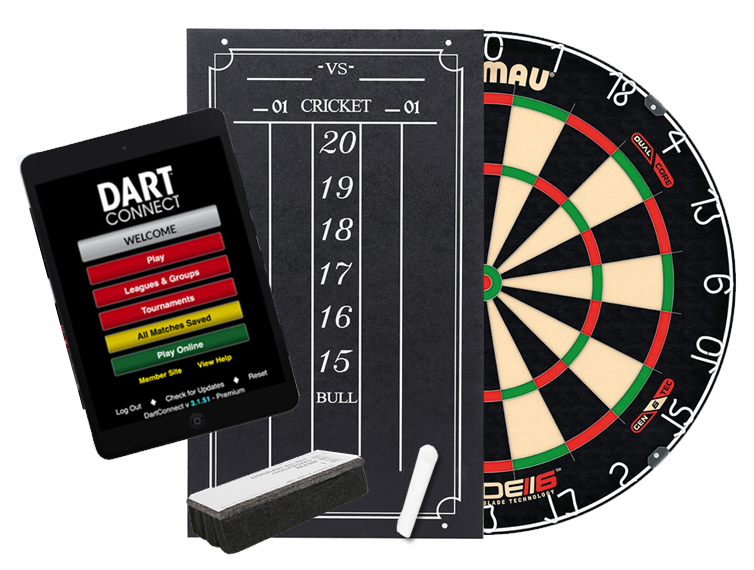
Chalking, even though our league uses DartConnect for most scenarios, manual chalking still happens at some tournaments, when DartConnect is not used, and when we play extended cricket! Chalking is an important responsibility, and good chalking helps keep a match running smoothly and fairly. If you are new to chalking, let the players know. Do not be offended if they correct your math—mistakes happen, even to experienced chalker’s. The important thing is to make corrections promptly and accurately.
Stand within arm’s reach of the board and position your body so you can clearly see the darts land while still allowing the players to see their score from the line. Your head and gaze should be on the dart board. Do not watch the player while they are throwing. Keep your attention on the board and the score. Being watched closely while throwing can be distracting and uncomfortable for the player. Wait until all three darts have been thrown. Never lean in to examine a first or second dart unless the current thrower specifically asks you to do so.
Always put the number scored on the outside and the score remaining on the inside. After subtracting the total score thrown, cross off the previous score and previous remainder, leaving only the current remainder uncrossed.
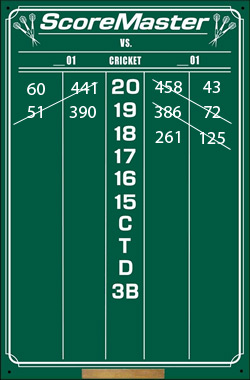
When you run out of room at the bottom of the scoreboard, in between player turns, erase the numbers from the top, while leaving only a few of the most recent scores at the bottom. This provides a record in case a math or scoring correction is needed. Continue writing again at the top and once both opponents have completed their turns and a new remaining score has been recorded at the top of both players, now the older scores at the bottom may be erased.
Your handwriting must be large enough and neat enough for everyone at the line to read easily. Make sure numbers such as 1 and 7 are clearly distinguishable. Also writing “T” (for ton) instead of 100 is fine in local league as long as the teams know what it means, but if your scoring at a large tournament, make sure writing a “T” instead of 100 is acceptable.
The Chalker is neutral. Regardless of the team or affiliation of the Chalker, the Chalker may only call out the total score or, if asked, the remaining score. Never tell a player what combination to throw—for example, do not tell a player that they have double 16 remaining. You may only state that their remaining score is 32.
If a scoring error occurs, it must be corrected before that same player throws again. Once the player has thrown again, the previous score stands.
Dart Etiquette
Dart etiquette is an important part of competitive play. Frustration happens, especially when the darts are not cooperating, but frustration is never an excuse for poor behavior. Do not throw or whip a dart at the board in anger after a bust, and do not kick walls or otherwise damage property while retrieving your darts.
Likewise, do not curse or confront another player while you are at the line. If another player, spectator, or even your opponent is creating a distraction—whether by talking, rattling darts, or otherwise making noise—remain patient. Pause, turn around, and politely ask that the distraction stop while you are shooting. If necessary, address the matter calmly after the match.
Welcome to the world of Dart Etiquette. Swearing, throwing darts anywhere other than at the board, heckling opposing teams or players while they are at the line, and wagering on a match or game involving your own team are all no-no’s in the SFDL and in most other dart organizations.
It should also go without saying that passing gas at the line is unacceptable. You may find it funny, but your opponent, the Chalker, and everyone nearby may not. Respect the people around you.
Whenever possible, turn off or silence your cell phone while playing a match. Phone calls, notifications, alarms, and other sounds can be a significant distraction to players at the line.
Physical confrontations are never acceptable. Any physical confrontation brought to the attention of the Board of Directors will be investigated and acted upon accordingly. In other words, don’t do it. We are all adults, and disagreements should be handled accordingly.
Sportsmanship
At the start of a dart match, all players from opposing teams should acknowledge one another with a handshake, fist bump, or similar gesture of sportsmanship. The same courtesy should be extended at the conclusion of the match.
Before an individual or doubles match, it is customary to wish your opponents good luck and offer a handshake or fist bump. At the end of the match, whether you win or lose, a sincere “good game” and a parting handshake or fist bump demonstrates good sportsmanship and great dart etiquette.